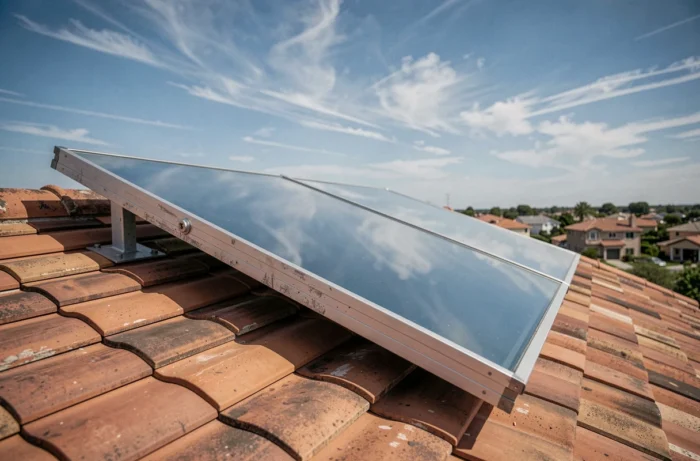
A solar water heater is not just about installing collectors on a roof and connecting a tank. The sizing of the primary circuit, the choice of heat transfer fluid, and the backup strategy determine the actual coverage rate of the system. Here, we detail the technical points that separate a high-performing installation from underutilized equipment.
Primary circuit and heat transfer fluid: the thermal heart of the system
The efficiency of a solar water heater primarily depends on the loop that connects the thermal collectors to the storage tank. In this loop, the heat transfer fluid circulates in a closed circuit, capturing heat at the absorbers and transferring it to the domestic hot water via a heat exchanger.
The fluid used is generally a water-glycol mixture, with the proportion varying according to the climatic zone. In frost-prone areas, insufficient glycol dosing poses a risk of damage to the heat exchanger and collectors. Conversely, overdosing degrades the thermal capacity of the fluid and reduces heat transfer.
Circulation can be ensured by a pump (forced circulation system) or by thermosiphon. The thermosiphon exploits natural convection: the hot fluid, being less dense, rises to the tank placed above the collectors. This principle imposes a constraint on installation (tank on the roof or in the attic), but eliminates the electrical consumption of the pump and removes a potential point of failure.
For an eco-friendly household, solar hot water production via thermosiphon remains the most energy-efficient configuration in terms of operational gray energy.
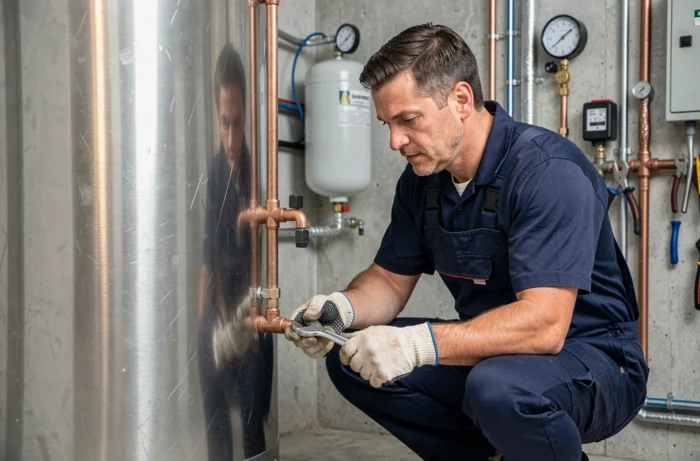
We recommend checking the compatibility of the heat transfer fluid with the seals and welds of the circuit. A degraded fluid (acidification after several years without draining) corrodes the heat exchanger, leading to a gradual drop in efficiency without visible signs from the outside.
Solar thermal collectors: flat plate, vacuum tubes, and actual efficiency
Flat plate collectors dominate the residential market. Their absorber, protected by tempered glass, converts solar radiation into heat with good efficiency as long as the temperature difference between the collector and the outside air remains moderate.
Vacuum tube collectors operate differently. The vacuum between the inner tube (absorber) and the outer tube (envelope) reduces convection losses. Their efficiency is better maintained in cold or overcast weather, making them relevant for installations in less sunny areas.
The choice between these two technologies is not based solely on peak efficiency. We observe that installers often underestimate the impact of summer overheating on vacuum tube collectors. In summer, without sufficient draw-off, the stagnation temperature can far exceed the tolerance of the glycol, accelerating its degradation. A flat plate collector, less efficient in winter, manages overheating better due to its higher thermal losses.
Collector area and tank volume
The ratio between the area of solar collectors and the volume of the storage tank determines the coverage rate of domestic hot water needs. Oversizing the collectors relative to the tank leads to frequent stagnation episodes. Undersizing excessively stresses the backup system.
A consistent ratio is around 1 m² of flat collector for 50 to 75 liters of tank, depending on local sunlight and the household’s draw-off profile. This ratio is not a universal rule: it should be adjusted according to the number of occupants and the hourly distribution of consumption.
Backup strategy and annual solar coverage rate
No solar water heater covers all the needs of a household throughout the year. The annual coverage rate generally ranges between 50 and 80%, depending on the region and the size of the installation. The remainder is provided by a backup system.
The backup can be integrated into the solar tank (immersed electric resistance) or separate (boiler, heat pump). From an ecological standpoint, a backup resistance powered by a renewable electricity contract or coupled with a self-consumption photovoltaic installation reduces the residual carbon footprint of the hot water system.
We recommend placing the backup regulation probe at mid-height in the tank, not at the bottom. A low positioning triggers the backup too early and reduces the actual solar contribution. This implementation detail can shift the coverage rate by several points.
- Integrated backup (electric resistance): simple, inexpensive, but consumes electricity during off-peak or peak hours depending on the programming.
- Separate backup (wood boiler, heat pump): allows for the dissociation of backup energy management and optimization of each source independently.
- Solar photovoltaic backup via a router (power diverter): excess PV production powers the tank’s resistance, increasing self-consumption and bringing the household closer to a nearly zero carbon balance for hot water.

Financial aid for solar water heaters: what changes since September 2026
The financing framework has significantly evolved. Since September 1, 2026, solar water heaters are no longer eligible for MaPrimeRénov’ in the “by gesture” pathway in metropolitan France, according to decree no. 2026-822 of August 25, 2026. However, they can still be integrated into a comprehensive renovation.
Energy savings certificates (CEE) take over. An order from August 17, 2026, provides for a bonus for solar water heaters, effective from October 1, 2026, according to Effy. The level of the bonus varies based on the household’s income and the type of equipment being replaced.
Two other schemes remain accessible:
- The zero-interest eco-loan (éco-PTZ), which finances thermal solar without income conditions.
- The reduced VAT on supply and installation, applicable to homes over two years old.
Notably for overseas territories: solar water heaters remain eligible for the “by gesture” pathway in several overseas departments and communities, a differential treatment reflecting the higher solar potential and dependence on imported fossil fuels in these areas.
The financial structuring of a solar thermal project now requires combining bonified CEEs, eco-PTZ, and reduced VAT to recreate a level of aid comparable to that which existed before September 2026. A household engaged in a comprehensive renovation retains access to MaPrimeRénov’, but the solar water heater must then be part of a coherent package of work with a minimal energy gain across the entire home.