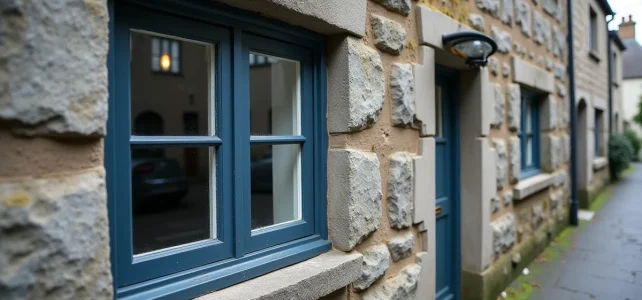
On a granite longhouse in Finistère, blue-gray windows frame the stone without competing with it. A few kilometers away, a neo-Breton house displays sage green joinery that contrasts with the white render. The choice of color for windows in Brittany is not a matter of personal taste: it depends on the local urban planning regulations, exposure to sea spray, and the facade material. Here’s how to approach this project without missteps.
Brittany’s local urban planning and window colors: what the town hall really allows
Before flipping through a RAL color chart, one should consult the Local Urban Plan of their municipality. In Brittany, the rules vary greatly from one town to another. Some coastal municipalities impose strictly neutral shades (white, gray, stone tones) for joinery visible from the public road.
Further reading : How to Optimize Your Recruitment with Tailored and Efficient HR Services
Other communities have taken the opposite approach. Since 2024, the municipality of Plouguerneau has adopted a facade color guide as part of the “Small Towns of Tomorrow” program. This document allows bright pastel shades for joinery, such as sky blue or sage green, in addition to traditional white facades. The stated goal: to energize historic centers while respecting architectural identity.
In practical terms, to harmonize windows with Breton architecture, one should start by downloading the local urban plan from their town hall or intermunicipal website. The document specifies the accepted palettes by sector, sometimes street by street. Submitting a prior declaration of work with a color outside the palette risks a refusal and having to redo everything.
Related reading : Discover how to elevate your events with trendy and elegant party supplies
Granite, white render, or colored coating: adapting the shade to the wall
The color of windows is not chosen in isolation. It responds to the facade material, which dictates the overall chromatic temperature.
Exposed granite facade
Breton granite tends toward bluish gray, rosy beige, or golden yellow depending on the quarries. On this type of wall, neutral and muted shades work best: anthracite gray, off-white, slate blue. A pure white creates too harsh a contrast with the stone. Pearl gray remains a safe choice, as it reflects the natural hues of granite without overwhelming the joint relief.
White render or light coating
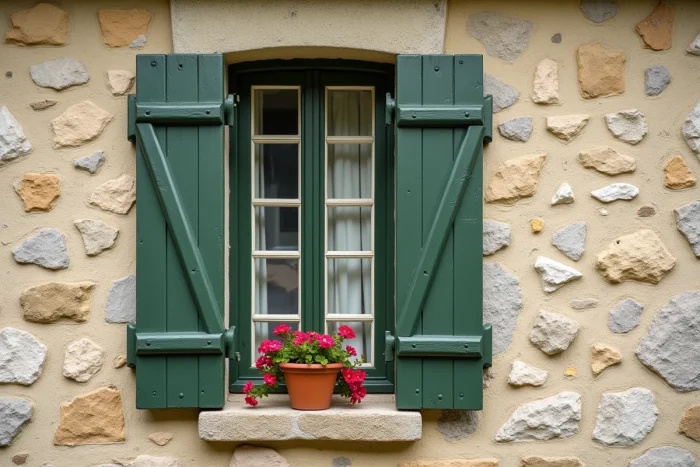
Néo-Breton houses from the 1960s to 1990s often feature white or cream render. Here, there is more latitude. Blues (Brittany blue, petroleum blue), greens (sage green, slate green), and Basque reds integrate well, provided one stays within moderate saturations. A very bright blue on white render gives a “holiday home” effect that ages poorly.
Tinted coating or wood cladding
On ochre render or greyed Douglas cladding, one seeks complementarity. Cream white or light gray joinery brings in light. Natural wood facades can also support black windows, but this combination requires generous glazing to avoid weighing down the facade.
Sea spray and the Breton climate: choosing a color that lasts over time
One can find the perfect shade on a color chart and see it degrade in just a few seasons. Salt spray accelerates the fading of dark shades on exposed joinery, a phenomenon well documented by Breton facade specialists. In recent years, the trend has shifted toward pearl grays or blue-grays that resist salt corrosion better.
The material of the window also plays a role in color retention:
- Mass-tinted PVC retains its color longer than surface-painted PVC, but the choice of shades remains limited (white, gray, a few wood imitations).
- Thermally coated aluminum offers the widest RAL palette and resists salt well, provided one chooses a treatment certified for marine environments.
- Painted wood requires regular maintenance (sanding and repainting every five to eight years by the sea), but allows for any color and naturally matches older buildings.
For a house less than a kilometer from the coast, favoring thermally coated aluminum or mass-tinted PVC limits repainting. Feedback varies on this point depending on the orientation of the facade: a full west exposure facing prevailing winds wears out faster than a sheltered facade.
Color of shutters and doors: coordinating without standardizing
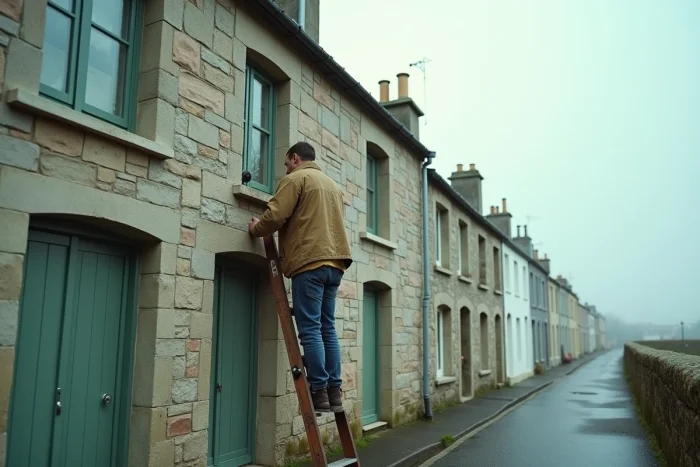
Windows and shutters are often thought of as a block, but separating them sometimes produces a more interesting result. A common approach in Brittany is to install windows in a neutral tone (gray, off-white) and reserve the strong color for the shutters. This method allows changing the shutter color without touching the windows, reducing the cost of a future update.
On village houses, the front door can also serve as a color accent. A deep blue or brick red on the door, paired with gray windows, is enough to personalize a facade without overloading it. This principle is found in the Plouguerneau guide, which encourages homeowners to treat the door as a unique element in the chromatic composition of the facade.
Three color combinations tested in the Breton field
Rather than listing dozens of RAL shades, here are three combinations that frequently appear on renovation sites in Brittany:
- Gray granite + anthracite gray windows (RAL 7016) + slate blue shutters: understated, versatile, enhances the stone. Works equally well on a longhouse or a recent pavilion.
- White render + sage green windows + Brittany blue door: a bolder combination, suitable for town centers where the local urban plan allows it. The sage green softens the contrast with the white.
- Sand tone coating + cream white windows + pearl gray shutters: a discreet option for houses located in protected areas, near a listed building. Cream white avoids the clinical effect of pure white.
The final choice always depends on the local light. Breton brightness, often filtered by clouds, softens warm colors and brings out cool tones. A color sample placed against the wall on a cloudy day gives a more reliable idea than any digital simulation.