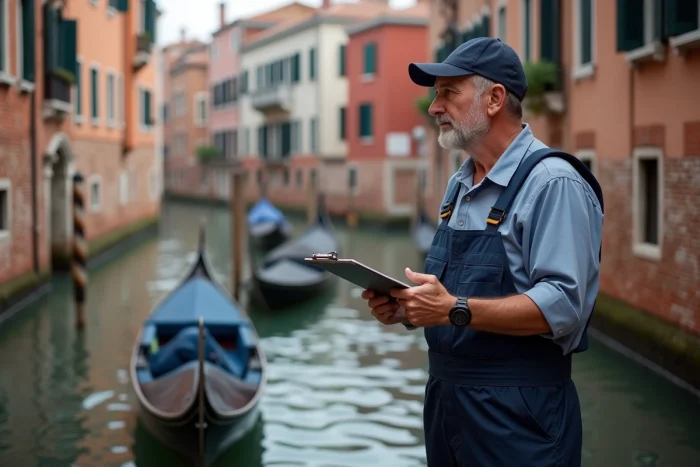
In Venice, there are no underground pipes connecting homes to the sewer system as we know it elsewhere. Here, the collection of fecal matter is still done by hand, following a schedule set by municipal decree. Some houses still rely on individual septic tanks, maintained at regular intervals by specialized companies. Despite stricter regulations since the 2000s, it still happens that wastewater flows directly into the canals.
Venice faces an invisible challenge: understanding the extent of the wastewater problem
Venice is in a constant battle to manage sanitation. Drinking water comes from the Vésubie, far from the lagoon, but separating wastewater from clean water is not simple here. Since the Middle Ages, the city has established strict sanitary rules. Yet, demographic pressure and the continuous flow of tourists put this balance to the test. The urban density and the crowds that roam the alleys increase health risks.
To limit these dangers, the evacuation of excrement in Venice relies on various methods, from manual pumping to more modern installations. Septic tanks, regularly emptied, are common, but residues sometimes make their way into the canals. Despite notable progress, water pollution remains a real issue. Authorities are increasing inspections and controls, aware of the collective risk at the slightest failure.
The issue of public hygiene occupies a central place in the city’s history. Archives are filled with examples where poor management of wastewater led to major health crises. Today, the situation has improved significantly, mortality linked to waterborne epidemics has decreased, but no one lets their guard down. Tourism, a pillar of the local economy, puts pressure on the networks and requires constant vigilance. For those who wish to delve deeper into the workings of excrement evacuation in Venice, the file “Evacuation of Excrement in Venice: What Really Happens? – By Caroline and CO” details the behind-the-scenes of this atypical management.
Why the canals are not sewers: myth, reality, and health stakes
Rumors die hard: many still believe that the canals of Venice are simply open sewers. In reality, the situation is much more complex. Since the Middle Ages, the city has implemented a strict sanitary regulation, orchestrated by local authorities. Wastewater is not left to chance. Keeping wastewater and drinking water apart has helped curb the waterborne epidemics that once wreaked havoc.
The urban configuration, dense and complex, makes the task challenging. Yet, the management of sanitation relies on collection systems, septic tanks, and regular emptying carried out by specialized boats. Analyzing the figures, we see that mortality has dropped, particularly thanks to the sanitation of housing, the creation of lazarettos, the organization of quarantines, and the establishment of sanitary cordons.
Public health in Venice depends on a delicate balance. As urban pressure increases, monitoring of facilities and enforcement of sanitary rules take on a strategic dimension. Preserving the quality of drinking water, protecting residents and tourists: this is the goal pursued. The sanitary reality of the city, fluid, shows that Venice has never stopped inventing solutions to safeguard life in the lagoon.
From pump boats to innovative solutions: how the city organizes itself daily
In Venice, nothing is left to chance. Pump boats navigate the canals, piloted by seasoned professionals. Their mission: to collect domestic wastewater and transport it to suitable treatment centers. Behind this discreet logistics lies a meticulously organized system, rhythmically aligned with the tides and the city’s unique architecture.
Supervision is ensured by historical actors: the health magistrate and the chief physician. These figures oversee the coordination of collection, monitor private installations, and check the compliance of septic tanks. The Saint Roch Hospital, the Pasteur Hospital, and the municipal hygiene office embody this institutional vigilance that has helped contain the risks of epidemics, both yesterday and today.
Several actions structure this management system:
- Collection by pump boats: a precise schedule to serve the most populated neighborhoods.
- Treatment of wastewater: systematic passage through approved facilities.
- Monitoring: regular inspections and controls across the entire city.
Under demographic and tourist pressure, innovation is making its way. Underground networks are evolving, equipment is modernizing, and new, more ecological approaches are being tested. Venice continuously adjusts its management of wastewater, balancing heritage and adaptation, so that the lagoon can continue to breathe.
In the changing light of the lagoon, Venice persists in reinventing its balance. Between centuries-old traditions and technical advancements, the city refuses to succumb to the fate of polluted waters. Here, each canal tells a story of resistance, each alley bears witness to a challenge met. And if, tomorrow, the City of the Doges became the unexpected example of a successful coexistence between heritage and urban ecology?