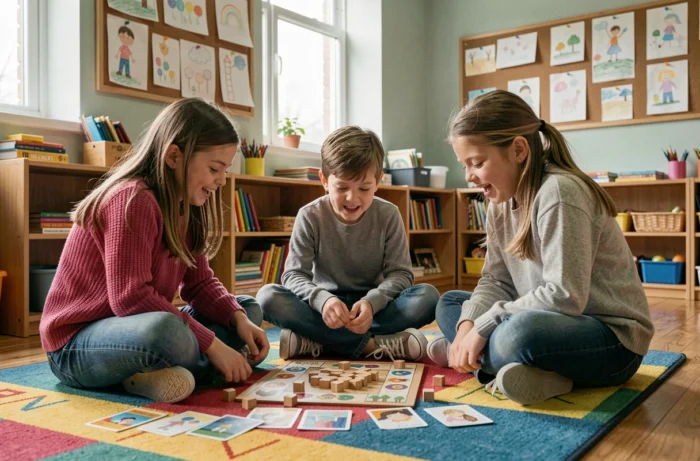
Measuring the effect of play on academic learning requires going beyond the intuition that “students love to play, so they learn better.” A meta-analysis published in 2024 in the Review of Educational Research (Barz et al.) shows that outcomes vary depending on the type of intervention, context, and objectives pursued. Play in school does not produce a uniform benefit: it all depends on its pedagogical design.
Pedagogical Design of Play: The Factor Underestimated by Curricula
The same meta-analysis distinguishes three categories of effects of digital games in the classroom: cognitive, metacognitive, and affective-motivational. A game can improve vocabulary retention without altering the student’s self-regulation ability, or stimulate motivation without advancing disciplinary skills.
This observation shifts the question. The issue is not whether play “works,” but what design characteristics produce a measurable effect. A poorly integrated board game with the curriculum can entertain without teaching. A serious game aligned with assessment objectives can yield real cognitive gains.
Recent research in game-based pedagogy, such as that compiled on the SDN Rennes website, confirms that alignment between the game mechanics and the pedagogical objective remains the primary criterion to check before deploying a game in the classroom.
Free Play, Guided Play, and Gamification: A Comparison of Approaches in the Classroom
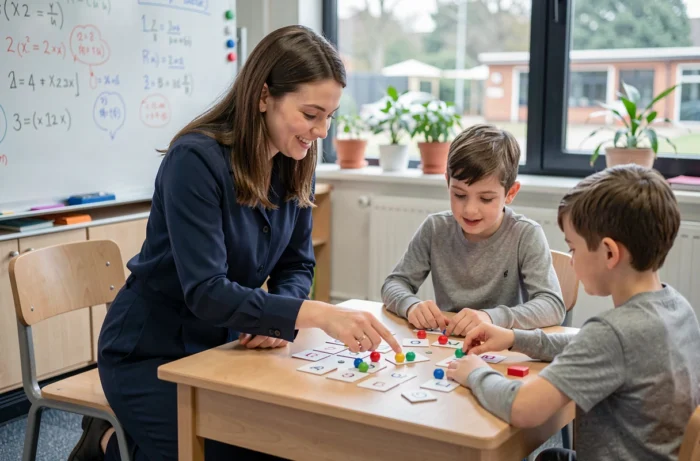
Not all forms of play engage the same learning levers. The table below summarizes the characteristics of the three main approaches documented by research.
| Approach | Role of the Teacher | Type of Learning Targeted | Main Limitation |
|---|---|---|---|
| Free Play | Observer, facilitator | Social skills, creativity, exploration | Difficult to link to disciplinary objectives |
| Guided Play | Designer of the situation, active guide | Targeted cognitive skills (math, reading, science) | Requires precise pedagogical preparation |
| Gamification | Integrator of game mechanics (points, badges, levels) | Engagement, motivation, perseverance | Risk of extrinsic reward without deep learning |
Guided play appears to be the most promising format for disciplinary learning. The teacher structures the activity around a specific objective while allowing the student some initiative.
In contrast, gamification produces more mixed results. The addition of game mechanics does not guarantee cognitive gain if the underlying content remains identical to a traditional exercise. Measured engagement (time spent, completion rate) does not always reflect consolidated learning.
Teacher Training and Implementation: The Real Bottleneck
Recent research published in Frontiers in Education (2026) identifies a paradox: the main obstacle to pedagogical play is not student buy-in, but teachers’ ability to integrate it. Three facilitating factors emerge from the analyzed studies:
- Initial and ongoing training in game-based pedagogical approaches, which remains marginal in most teaching curricula in France
- Collective planning among teachers to articulate play with assessment sequences and disciplinary progressions
- Explicit alignment between game mechanics and assessment criteria, without which the playful activity remains disconnected from the educational pathway
Without this framework, play in the classroom reduces to a recreational moment. The student has fun, the teacher observes, but no trace of learning is recorded in formal assessment.
Lack of Longitudinal Data: What Research Still Doesn’t Know
A review published in the International Journal of Early Childhood (2026) points out a blind spot in the scientific literature on educational play. The majority of studies measure short-term effects, over a few weeks. Longitudinal protocols, which would follow cohorts of students over several years, remain rare.
This deficit prevents answering a central question: do the skills acquired through play persist over time? Does a student who improves in mental arithmetic through a digital game retain that advantage six months later, a year later?
The same review highlights the absence of homogeneous theoretical frameworks. Researchers use varying definitions of the word “play,” different metrics to measure learning, and cultural and educational contexts that are difficult to compare. This heterogeneity makes meta-analyses fragile and limits the ability to formulate generalizable recommendations.
Assessment and Pedagogical Play: A Couple Still Poorly Articulated
The gap between playful practice and formal assessment constitutes a structural barrier. In most classrooms, assessment relies on written exercises, standardized tests, and standardized competency grids. Play, by nature, produces different data: observable behaviors, adopted strategies, interactions among peers.
As long as school assessment systems do not provide a framework to value these traces of learning, play will remain perceived as an optional supplement. The teacher who uses a game in class must then “retranslate” the acquired skills into the format expected by the institution, which adds to their workload.
- A role-playing game in history allows for observing understanding of a period but does not produce a grade comparable to a written test
- An escape game in science mobilizes collaborative reasoning, but individual assessment grids do not capture this dimension
- A digital game in math generates progression data, but their exploitation assumes analytical tools that few institutions possess
The question is therefore not only “how to integrate play in the classroom,” but how to evolve assessment so that it recognizes the learning produced by play.
The available data shows that pedagogical play is not lacking in promise or student buy-in. What it lacks are longer research protocols, structured teacher training, and an assessment system capable of measuring its real effects.