
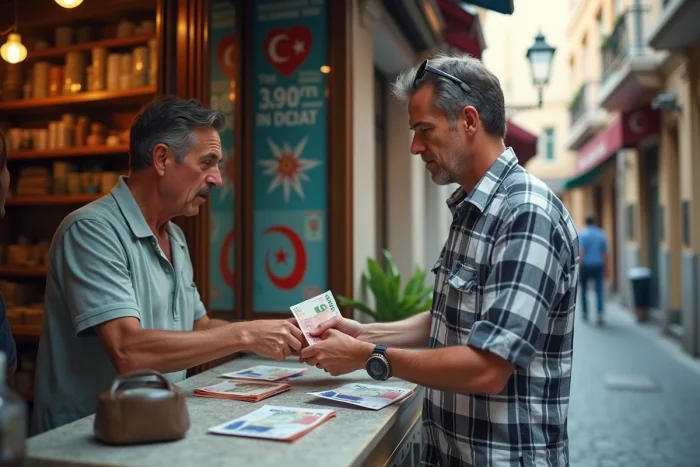
At the Grand Bazaar in Istanbul, a carpet seller displays his prices in euros. The European tourist thinks it’s convenient, avoiding mental conversion. The problem: the rate applied by the merchant has nothing to do with the market rate. On this single transaction, one can lose the equivalent of a full meal. The question of whether it’s better to pay in euros or Turkish lira hinges on these details, not on a theoretical choice.
Dynamic Currency Conversion in Turkey: The Payment Terminal Trap
Before even discussing currencies, it’s essential to understand a mechanism that most guides gloss over: dynamic currency conversion (DCC). When paying by credit card in Turkey, the terminal sometimes displays an option to “pay in euros” or “pay in Turkish lira.”
You may also like : How to choose a suitable SIM card for your Doro 2404 phone?
Choosing euros on the terminal seems reassuring. You see the amount in your currency, and you feel protected. In reality, the dynamic conversion rate is set by the merchant or their bank, with a margin that often exceeds that of your own French bank.
The result: you end up paying more while believing you’re simplifying things. The ground rule is simple. When the terminal offers a choice, always select Turkish lira (TRY). Your issuing bank will then apply its own rate, generally closer to the actual market rate. To know when to pay in euros or Turkish lira in Turkey, this guide details specific situations.
Read also : How to Write a Captivating Introduction for Your Blog in 2024
This mechanism does not only apply to standard Visa or Mastercard cards. Travel cards like Wise or Revolut are also exposed to it, even though their conversion fees are lower. The reflex remains the same: always refuse the euro conversion offered by the terminal.
Paying in Euros at a Turkish Merchant: What the “Convenient” Price Costs You
In tourist areas (Istanbul, Antalya, Cappadocia), many businesses accept cash euros. This is common in hotels, restaurants near sites, and souvenir shops. This acceptance is convenient, but it is not normative: the Turkish lira remains the only official currency in Turkey.
The merchant who accepts your euros sets their own exchange rate. They have no obligation to align with the market rate. At the end of May 2026, the euro was trading around 51 to 53 TRY according to sources. A merchant can very well apply a rate of 45 or 48 TRY for 1 euro, pocketing the difference without the tourist realizing it.
In practical terms, here’s what it changes over a day of spending:
- A meal priced at 500 TRY costs you about 9.50 to 10 euros at the market rate, but the restaurateur might ask for 12 euros “to simplify”
- A souvenir priced at 200 TRY amounts to less than 4 euros at the actual rate, but the seller rounds it up to 5 euros without hesitation
- A taxi or a transfer negotiated in euros almost always includes a comfort margin for the driver
Over a week, these accumulated discrepancies represent an additional lost meal budget. Paying in Turkish lira protects against fanciful rates applied in tourist areas.
Where and How to Obtain Turkish Lira at the Best Rate
Once convinced to pay in TRY, the practical question remains: how to obtain it without incurring fees.
ATM Withdrawals in Turkey
ATMs are everywhere in Turkey, including in airports and small towns. Withdrawing Turkish lira from an ATM remains one of the most advantageous methods, provided you follow two points. Refuse the euro conversion if the ATM offers it (the same logic as the payment terminal). And prioritize larger withdrawals to amortize the fixed fees that some Turkish banks apply per transaction.
Returns vary on this point depending on the banks: some charge a fixed fee per withdrawal, others do not. Checking with your French bank before departure avoids surprises.
Exchange Offices in Istanbul and Tourist Areas
Exchange offices (döviz bürosu) offer competitive rates, especially in the shopping districts of Istanbul like Beyoglu or Sultanahmet. Comparing two or three offices before exchanging takes five minutes and can save several percent on the rate.
Avoid: airport exchange counters, which apply significantly higher margins. If you arrive without cash, it’s better to withdraw a small amount at the airport ATM and exchange the rest in the city.
Bank Card or Cash in Turkish Lira: What Mix to Adopt On-site
Credit cards are accepted in most businesses in Turkey, especially in Istanbul and large cities. Hotels, restaurants, and supermarkets almost all have a terminal. However, markets, small artisans, dolmus (minibuses), and some taxis only accept cash.
The most effective mix for a trip to Turkey:
- A credit card (ideally with no exchange fees or reduced fees) for regular payments, always selecting Turkish lira on the terminal
- A stock of cash in Turkish lira for markets, small shops, and tips
- A few euro bills kept in reserve as a safety net, not for daily payments
The euro serves as a safety net, not as the primary means of payment. This distribution covers almost all situations without exposing your budget to unfavorable rates.
The Turkish lira fluctuates, rates change from day to day, and each intermediary (bank, merchant, exchange office) takes their margin. The only real lever for the traveler is to maintain control over who does the conversion. Paying in TRY and letting your own bank manage the rate remains, in the vast majority of cases, the least expensive choice.