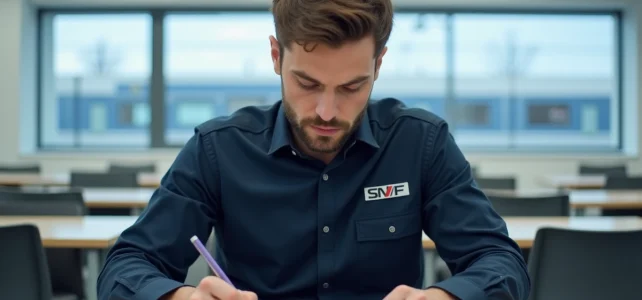
The SNCF psychotechnical tests for the train driver position are not just logic multiple-choice questions. They serve as a disqualifying filter applied before any operational interview, meaning that a technically motivated candidate can be eliminated without ever meeting a manager. Understanding the mechanics of these tests, their actual weighting, and the recurring traps radically changes the preparation.
Psychomotor tests and safety positions: the challenge candidates underestimate
The train driver positions fall under the “safety positions” category at SNCF. As such, they include psychomotor tests that are absent from standard recruitment processes. These tests measure hand-eye coordination, reaction time, and the ability to simultaneously process multiple streams of visual information.
Related reading : How to Harmonize Your Windows with Breton Architecture: Color Tips and Inspirations
We observe that the majority of candidates focus their preparation on logical reasoning and completely neglect this component. Psychomotor coordination cannot be improvised on the day of the test. It relies on automatism that only regular training can stabilize.
Specifically, it involves responding to visual or auditory stimuli within a constrained time, sometimes managing two tasks in parallel. This type of exercise engages working memory and inhibition (the ability to refrain from reacting to a non-relevant stimulus). A good score in logic does not compensate for a reaction time that is too slow or poor coordination.
Related reading : Tips and Effective Methods to Revitalize an Old Rosebush in Your Garden
To prepare for this, we recommend dual-task exercises: for example, following an auditory instruction while processing visual information. Some “brain training” applications offer this type of modality, even if they do not exactly replicate the SNCF protocol.

Factorial aptitude battery: anatomy of cognitive subtests
The SNCF psychotechnical battery consists of several subtests evaluating distinct cognitive dimensions. To fully understand the psychotechnical tests for SNCF train drivers, it is important to know that the core remains the same regardless of the targeted position, with additional subtests added according to the function.
The dimensions systematically evaluated include:
- Logical reasoning: numerical sequences, matrices, analogies. The timer is tight, which penalizes candidates who seek perfection rather than consistency.
- Spatial aptitude: mental rotation of objects, folding patterns, symmetries. This skill is directly related to reading technical diagrams and navigating a railway environment.
- Verbal aptitude and fluency: understanding written instructions, technical vocabulary, spotting anomalies in a text. Native French-speaking candidates are not immune to a low score if their reading speed is insufficient.
- Attention-concentration: barrage of signs, spotting targets in a flow of information. The attention test is often the most discriminating because it reveals resistance to monotony, an essential quality in the driver’s cabin.
A technical point often overlooked: the subtests are timed. Each unanswered item counts as a mistake. It is better to respond quickly with a controlled error rate than to aim for perfection on half of the items.
Personality test and feedback interview: what really matters
For driver positions, taking a personality test followed by an interview with a psychologist or recruiter is mandatory. This is not a trivial questionnaire.
The personality test does not have “correct answers” in the strict sense, but it detects inconsistencies. Responding in a socially desirable manner to all questions triggers a high social desirability index, which invalidates the profile or, at a minimum, alerts the psychologist during the feedback session.
We recommend a simple approach: respond spontaneously, without trying to guess what the recruiter expects. The questions are designed to trap candidates who overplay reliability or calmness. An authentic profile with some rough edges is perceived more favorably than an artificially smooth profile.
The feedback interview that follows is an opportunity for the psychologist to delve into the tension areas of the profile. If the test reveals low stress tolerance but the candidate argues with concrete examples of managing difficult situations, the raw result can be put into perspective. Conversely, a good score followed by vague responses can harm the candidate.

Preparation strategy for SNCF psychotechnical tests: prioritize the right levers
The consistency of training matters more than the volume. Three weeks of daily thirty-minute sessions yield better results than a last-minute revision marathon.
Target weaknesses rather than reinforcing strengths
After a first mock test, identify the subtest where your score is the lowest. Dedicate the majority of your preparation time to this dimension. Marginal gains are much more significant on a weak skill than on a skill already mastered.
Realistic testing conditions
The tests are taken on a computer, sometimes at home, sometimes in a dedicated center. Systematically train on-screen, under timed conditions, in a quiet environment. Transitioning from paper to screen degrades the performance of many candidates who have not anticipated this interface difference.
Do not overlook the overall security dimension
Candidate feedback shows that drug screening and criminal record checks are now mentioned almost as often as cognitive tests in the recruitment process. Success in psychotechnical tests is not enough if the overall security file has a flaw.
The SNCF recruitment process for train drivers is based on a logic of successive filters. The psychotechnical tests are the first, and they eliminate without appeal. A methodical preparation focused on psychomotor tests and attention subtests provides a concrete advantage over candidates who only review pure logic.